
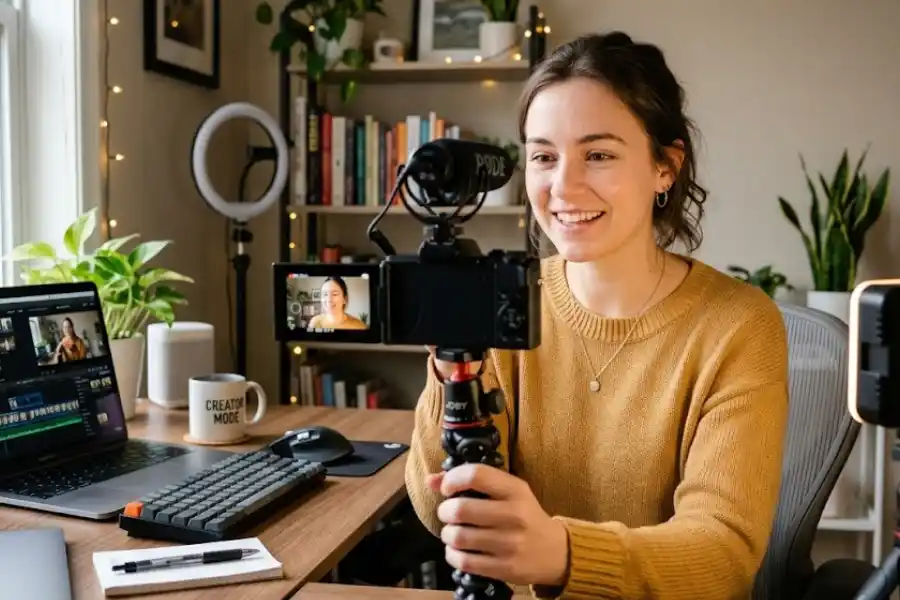
Canon G7X Mark III for YouTubers: Why It Still Wins in 2026
The Canon G7X Mark III has been on the market since 2019, and by every expectation it should have faded from relevance by now. Newer cameras have launched. Mirrorless options have dropped in price. Smartphone cameras have closed the quality gap in well-lit conditions. Yet if you look at what working YouTubers are carrying in 2026, the G7X Mark III still appears in bags, on desks, and in travel kits with a frequency that newer competitors have not managed to displace.
That staying power is not accidental. The G7X Mark III arrived at a point when Canon understood precisely what video creators needed that the previous generation missed. A one-inch sensor capable of handling available light without falling apart. A flip screen that works reliably for solo filming. A dedicated microphone input that separates it from almost every other compact on the market. A body compact enough to fit in a jacket pocket without second-guessing.
This article covers every aspect of the G7X Mark III that matters specifically to YouTubers: video quality, autofocus reliability, audio setup options, battery behavior, low-light performance, comparisons to competing cameras, and where the camera falls short. If you are deciding whether this camera belongs in your content setup, this is a thorough starting point.
What Makes the G7X Mark III Different From Other Compact Cameras
Most compact cameras are built with the photographer as the primary user and the videographer as an afterthought. The G7X Mark III reversed that priority in a meaningful way.
The camera sits on a 1-inch 20.1 megapixel CMOS sensor, which is significantly larger than what you find in most compact point-and-shoots. A larger sensor gathers more light per pixel, which directly translates to cleaner footage in mixed and low-light situations. For YouTubers who film indoors without a full lighting setup, this sensor size matters more than almost any other number on the spec sheet.
Canon included a Digic 8 image processor that handles noise reduction, color science, and video processing in a way that gives footage a polished look without requiring heavy post-production work. The processor also enables direct YouTube streaming via a smartphone connection, a feature Canon added specifically with content creators in mind rather than casual photographers.
The body is a combination of aluminum and polycarbonate that gives the camera a solid feel without the fragility common to cheaper compacts. The control layout keeps the most-used video settings within a thumb’s reach, reducing how often you need to interrupt a recording session to adjust something on the menu.
The camera also received several firmware updates after launch that added vertical video recording, which is relevant for creators who post YouTube Shorts, Instagram Reels, or TikTok content alongside their main channel format.
Video Specifications That Matter for YouTube Content
The G7X Mark III records 4K video at 30 frames per second with a 1.07x crop applied to the sensor. The crop is small enough that it does not meaningfully change your field of view from the 24-100mm equivalent zoom range, and the 4K output is sharp and detailed when exported and uploaded to YouTube.
At 1080p, the camera records up to 120 frames per second, giving you usable slow-motion footage at four times normal playback speed. For travel vloggers, reaction channels, or anyone who wants to add visual variety to a talking-head format, the 120fps mode is one of the most consistently used features among G7X Mark III owners.
Bitrate tops out at 120 Mbps in 4K, which is sufficient for YouTube delivery without producing file sizes that overwhelm editing setups running on mid-range laptops.
Color profile options include Canon Log, the flat low-contrast picture style that gives you more room to grade colors in post-production. Canon Log on the G7X Mark III is not as workable as what a cinema camera provides, but it offers noticeably more latitude than shooting in a standard picture style when conditions push toward high contrast scenes or brightly backlit subjects.
For creators who do not want to color grade at all, Canon’s Standard and Neutral picture styles produce pleasing results straight from the camera with no editing required. The color science tends toward warm, natural tones that work well for talking-head and lifestyle content.
The Flip Screen: Why Solo Creators Film Better Because of It
A camera without a flip screen puts a solo creator in a difficult position. They either guess at their framing every recording session, or they add a separate monitor to the setup just to see themselves. Both options add friction to a workflow that should stay fast and portable.
The G7X Mark III’s flip screen is a 3-inch touchscreen LCD that rotates fully upward to face the front of the camera. When you are filming yourself, the screen shows exactly what the lens is capturing in real time. You can confirm your exposure, check that your face sits in focus, verify your headroom, and see whether the background reads the way you want it without needing any additional equipment.
The touchscreen doubles as a focus point selector during recording. Tapping a subject on the screen pulls focus directly to it, which works well when you shift your gaze or move slightly in the frame. For interview-style content where a second subject enters the shot, this tap-to-focus behavior keeps the camera responsive without requiring you to touch any physical buttons.
One limitation worth noting: the flip screen has no sun visibility coating, which makes outdoor filming in bright conditions harder to judge on the LCD. A small clip-on shade addresses this without adding significant bulk to the camera. Most G7X Mark III owners who shoot outdoors regularly keep one in their bag.
Audio Capabilities: The Microphone Input That Defines the Choice
Audio is where the G7X Mark III clearly separates itself from most compact cameras at this price.
The camera includes a 3.5mm microphone input on the side of the body. This single feature is the deciding factor for many YouTubers when they compare compact options. The Sony ZV-1, the most frequently mentioned alternative, does not include an external microphone input. The G7X Mark III does, and that difference reshapes the entire audio setup conversation for creators who take sound seriously.
In practice, you can connect a compact directional microphone like the Rode VideoMicro, the DJI Mic 2 wireless receiver, or a Sennheiser MKE 200 directly to the camera body. Audio quality improves significantly over the on-camera microphone without adding a second recording device or requiring audio syncing in post.
The on-camera microphone is a front-facing stereo arrangement that performs adequately in quiet, treated indoor spaces. In any room with reflective walls and ambient noise, the on-camera pickup gets noticeably muddy. Wind noise outdoors is a consistent problem even in light breezes. A foam or deadcat windscreen helps when you have to film outside without an external mic connected.
The camera does not include a headphone monitoring jack. You cannot listen to your audio in real time during recording. For most solo YouTube creators this is a workable situation since reviewing clips immediately after shooting catches any audio problems before you move on. For live streamers and event videographers, the lack of monitoring is a more significant limitation that may push them toward a different option.
Autofocus Performance: Reliable for Most YouTube Formats
The G7X Mark III uses Dual Pixel CMOS AF, Canon’s phase-detection autofocus system that works by splitting each pixel into two photodiodes, comparing signals from each half, and calculating focus direction and distance with more precision than a contrast-only system.
For talking-head YouTube content where the creator stays relatively stationary and the distance between face and lens remains consistent, the autofocus locks quickly and holds well throughout a recording session. Face detection works reliably in good lighting and continues to perform in lower light situations where other systems would hunt or lose the subject.
Where the autofocus becomes less dependable is in fast lateral movement. If you are filming a walking segment and moving perpendicular to the lens axis, the system occasionally drifts before re-acquiring focus. This is not a significant issue for most YouTube formats, but it is worth understanding if your content involves exercise demonstrations, active outdoor filming, or any scenario where you are crossing the frame at speed.
Eye-tracking is absent from this camera, which is one of the clearer gaps when compared to newer Sony options at a similar price. The face detection is reliable enough for the majority of YouTube content formats, but if precise eye-level focus is a priority for your production style, the Sony ZV-E10 II or A7C at a higher price point offers more exacting subject tracking.
Image Stabilization During Handheld and Vlog Shooting
The G7X Mark III’s optical image stabilization sits inside the lens barrel and reduces the appearance of hand shake in video mode. Canon’s IS performs well for minor movement and stationary holding, keeping footage steady when your hands are not perfectly still.
For walking vlog footage, the stabilization smooths out small tremors but does not eliminate the natural bounce that comes from a normal walking gait. The result looks like handheld footage from a stabilized compact, which is to say: better than no stabilization but still identifiably handheld. If you want fully smooth walking shots, pairing the G7X Mark III with a compact gimbal like the DJI OM 6 solves the remaining movement entirely. The camera’s size and weight make it a natural match for small smartphone-class gimbals.
For stationary talking-head filming, the stabilization is more than sufficient. Minor movement from breathing and small positional shifts are absorbed cleanly without any visible wobble in the frame.
Canon’s digital stabilization mode crops the image slightly to provide a more aggressive correction. The crop in 1080p is minimal. In 4K, the additional crop is more visible, so most creators who prioritize stabilization over maximum resolution use 1080p as their primary recording format.
Battery Life: The Real Numbers and How to Work Around Them
The G7X Mark III runs on a NB-13L battery rated for approximately 235 shots per charge under standard test conditions. In continuous video recording, you will typically get between 60 and 90 minutes of footage depending on resolution, screen brightness, and whether the camera is actively searching for faces.
For a full shooting day away from a power source, a single battery is not enough. YouTubers who use the G7X Mark III as their main camera almost universally carry at least two spare batteries. A third battery or a USB power bank extends the shooting day further, and the camera can be charged over USB-C while recording, which turns a power bank into an effectively limitless runtime for seated filming.
The USB-C charging behavior is one of the more useful qualities for travel creators. You can charge from a laptop, a standard wall adapter, or a portable battery without needing a dedicated camera charger in your luggage.
For studio-based creators who film at a desk with access to a power outlet, battery life is not a concern at all. The camera runs on continuous USB power throughout a recording session without draining the internal battery.
Low Light Performance: Filming Indoors Without Professional Lighting
The one-inch sensor gives the G7X Mark III a clear advantage over smaller-sensor compacts in low light. The native ISO range runs from 125 to 12800, with an extended setting up to 25600.
In YouTube use, the camera produces clean footage up to ISO 1600 without aggressive noise reduction needed in post. Between ISO 1600 and ISO 3200, a moderate grain structure appears that is visible on a large monitor but often acceptable after a light noise reduction pass in DaVinci Resolve or Premiere Pro.
Beyond ISO 3200, the noise becomes visible enough that most creators prefer to add practical lighting rather than push the sensor further. A small LED panel on a desk or a ring light positioned off to one side keeps you below ISO 1600 in most interior shooting situations without a large investment in lighting gear.
For comparison, the smaller 1/2.3-inch sensors found in older compacts and most action cameras become noticeably noisy above ISO 800. The G7X Mark III’s one-inch sensor gives you roughly two additional stops of usable range above those cameras, which makes a meaningful difference when you are filming in a home office or apartment without dedicated lighting.
G7X Mark III vs. Competing YouTuber Cameras
Several cameras occupy the same space as the G7X Mark III. Here is how each comparison plays out for YouTube use specifically.
Sony ZV-1 (First Generation): Smaller, lighter, and slightly less expensive. Sony’s color science is appealing and the autofocus is strong. The trade-off: no external microphone input. For any creator planning to connect an external mic, the G7X Mark III has a decisive advantage at a similar price.
Sony ZV-1 Mark II: Added a wider 18mm equivalent starting focal length and kept Sony’s color rendering. Still no external microphone port. The wider lens is useful in tight spaces, but the audio limitation remains. Best suited for creators who plan to use the on-camera microphone exclusively or carry a separate recorder.
Sony RX100 VII: A technically stronger competitor with excellent autofocus, a wider zoom range, and faster burst shooting. It is also significantly more expensive. The G7X Mark III gives up some autofocus precision to the RX100 VII but costs considerably less, and for YouTube talking-head and travel content, that autofocus gap rarely affects the final video.
DJI Pocket 3: A different category of camera built around a stabilized gimbal mechanism. The Pocket 3 produces extremely smooth footage straight from the body and is well-suited for active filming. The G7X Mark III produces better image quality in low light and gives more control over depth of field separation. The Pocket 3 wins on physical motion stability and portability for action-oriented content.
The G7X Mark III holds its position because no competitor at the same price has yet combined the external microphone input, one-inch sensor, and flip screen in a body this compact.
What Types of YouTubers Get the Most From This Camera
The G7X Mark III performs best for a specific range of creators rather than every type of channel.
Travel vloggers who need a small capable camera that fits in a carry-on bag and holds up across varied lighting conditions find it suits their requirements well. It is compact enough to use in public spaces without drawing attention, and the image quality handles the diverse lighting that travel filming involves.
Talking-head creators who film in a home office or studio setting get consistent results from the face detection autofocus and flip screen combination. Add an external directional microphone and a basic LED light, and this setup covers every technical requirement for a polished YouTube channel without a large equipment budget.
Lifestyle and daily vlog creators who want a camera they can carry everywhere find the G7X Mark III functions similarly to a phone in terms of portability, with image quality that stands clearly apart from any smartphone.
Where this camera is less suitable: action sports or fast-moving subjects where autofocus limitations matter, cinematic production where a full-frame sensor and interchangeable lenses are necessary, or channels that rely heavily on telephoto reach beyond 100mm equivalent.
Settings Configurations for Better YouTube Video
A few settings changes from the factory defaults make a noticeable difference in footage quality.
Set the picture style to Neutral rather than Standard. Standard applies saturation and contrast that looks appealing on the rear screen but tends to clip colors and over-sharpen fine detail in editing. Neutral gives a more balanced starting point that handles color grading without blowing out highlights. If you are comfortable grading in post, Canon Log gives the most flexibility.
Switch the autofocus to Face plus Tracking mode under the AF menu. This prioritizes your face whenever you are in the frame and follows you if you move, rather than requiring you to re-tap the screen each time you shift position.
Turn digital IS on for handheld filming and off when the camera is on a tripod. Using digital IS on a stationary mount adds a crop without benefit.
For audio, set the microphone attenuator to Auto in environments with variable sound. In a controlled quiet space, set it manually and keep an eye on the audio meter visible on the rear screen to confirm you are not peaking.
For YouTube delivery, record in MP4 rather than AVCHD. MP4 files from this camera are compatible with every editing application without conversion, and file management is more straightforward on both Windows and macOS systems.
Known Limitations Worth Understanding Before You Commit
The G7X Mark III has limitations that are worth stating without softening them.
The 4K video shows a rolling shutter effect in situations where the camera pans quickly. This is a readout speed limitation common to most compact sensors and is most visible in fast horizontal sweeps. Slowing pan speed down considerably reduces its visibility. For stationary or slow-moving filming, rolling shutter is not a visible problem.
The zoom range covers 24-100mm equivalent, with a maximum aperture of f/1.8 at the wide end that closes to f/2.8 at 100mm. The telephoto end is not long, limiting usefulness for sports filming, wildlife work, or any content that requires reaching across a distance.
There is no weather sealing on the body. Filming in rain or dusty environments requires a protective housing or careful placement, as moisture and fine particles can damage internal components that are not protected.
The camera overheats during extended 4K recording sessions in warm environments. Most users report a temperature warning appearing after 20 to 25 minutes of continuous 4K recording when ambient temperatures are elevated. For the majority of YouTube content this is not a problem since recording sessions rarely push past this duration, but for long-form interview formats or extended live streaming it requires planning around the limitation.
Read More: 10 Zillow Tips to Find Better Homes Before Other Buyers Do
Conclusion: A Camera That Earns Its Place in a Creator’s Kit
The Canon G7X Mark III has remained relevant in the YouTuber camera conversation because it was built around the right set of priorities for video creators. The one-inch sensor, the flip screen, the external microphone input, and the compact body together form a combination that no direct competitor at the same price has fully matched.
The limitations are real. Battery life needs planning. The autofocus is not the sharpest option available. Overheating in extended 4K sessions is a genuine consideration for certain use cases. But for the content formats most YouTubers produce, these limitations are manageable, and the camera’s consistent strengths show up in every recording session.
If you are putting together your first dedicated YouTube camera setup or looking for a capable secondary camera for travel and day-to-day content, the G7X Mark III remains one of the more sensible choices at its price point. The footage it produces looks good without requiring significant effort from the creator, which is exactly what a working YouTuber needs from a compact camera.
For the creator who wants a camera that performs reliably without requiring an engineering background to operate, the Canon G7X Mark III still belongs in the conversation in 2026.
For more creator-focused camera guides, check our articles on the best compact microphones for YouTubers, how to set up lighting for a home studio on a budget, and which editing software pairs best with Canon footage.
