
Pyjamaspapper: The Real Story Behind Sweden’s Quirky Name for Striped Printer Paper
You probably didn’t expect a single weird word to send you down a rabbit hole today.
But here you are, wondering what “pyjamaspapper” means. And the story behind it is more interesting than you’d think.
Here’s the short answer: Pyjamaspapper is not about pajamas at all. Most articles online will tell you it is. They’re wrong. The real story goes back to humming offices, giant machines, and a type of paper that once kept the entire business world running.
Let’s clear this up properly.
So, What Is Pyjamaspapper?
Pyjamaspapper is a Swedish word. It literally means “pajama paper.” But it was never used to describe clothing.
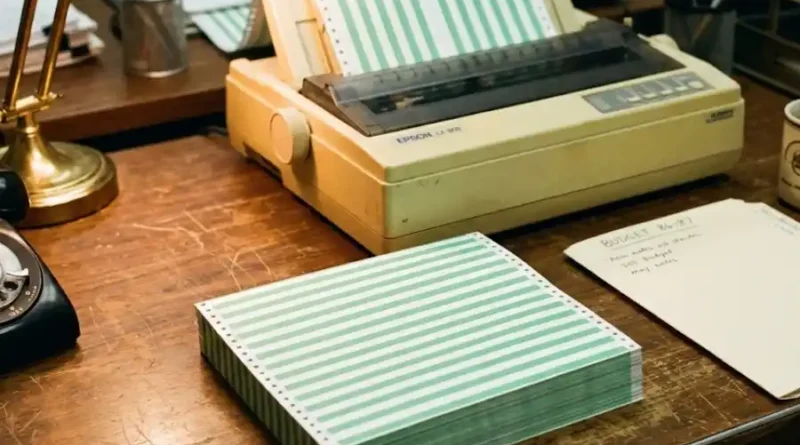
It was a popular nickname for a very specific kind of paper called continuous-feed paper (also known as tractor paper, fanfold paper, or green bar paper). This paper was fed through dot-matrix printers. It came in one long, connected sheet that folded back and forth on itself, like an accordion.
The paper had one very distinctive feature: alternating colored stripes. Usually green and white, sometimes blue and white. Those stripes ran horizontally across every page, from top to bottom.
When Swedish office workers looked at those stripes, they thought of one thing: pajamas.
Classic pajamas have horizontal stripes. So does this paper. The nickname was born, and it stuck.
Where Did This Paper Actually Come From?
The history of this paper is surprisingly long.
Continuous-feed paper was first developed around 1910. Back then, it was used in early machines called autographic registers. By the 1920s, it showed up in tabulating machines. These were big, clunky devices that helped businesses sort and count data.
Then computers arrived.
When businesses started buying their first computers in the 1950s, they had a problem. These machines processed huge amounts of information. And that information needed to be printed. A lot of it. Fast.
Normal single sheets of paper were too slow. Someone had to load each sheet by hand. That wasted time and caused errors.
Continuous-feed paper solved this problem perfectly. One giant stack of connected sheets could feed through a machine for hours without anyone touching it. The printer did all the work on its own.
By the 1980s, this paper was everywhere. When affordable dot-matrix printers arrived for small businesses and home offices, millions of people started using it. It became one of the most common office supplies in the world.
Why Did the Stripes Matter So Much?
The stripes were not there for decoration alone. They served a very real purpose.
Imagine you’re an accountant in 1978. You’ve just printed a 40-page financial report. Each page is packed with rows of numbers. No bold text. No color highlights. Just column after column of figures.
Now try to follow one single row across the entire page without losing your place.
It’s nearly impossible with plain white paper. Your eyes slide. You lose track. You make mistakes.
The green stripes changed everything. Every other row sat on a colored band. Your eye could follow a line of numbers all the way across the page without drifting. It sounds simple. But in a world where accuracy meant everything, it was a genuine breakthrough.
Banks loved this paper. Accounting firms swore by it. Shipping companies used it for manifests. Hospitals printed patient records on it. It showed up in warehouses, government offices, and airline ticket counters.
For about four decades, this striped paper was one of the most trusted tools in the entire business world.
What Did It Feel Like to Use?
This is something no other article will tell you, because most writers today never experienced it firsthand.
The paper came in a box. Inside, the pages were folded in a tight, neat stack. When you opened the box and pulled up the top sheet, the rest followed like a chain. It was oddly satisfying.
You threaded the edges into the tractor mechanism on the printer. Those edges had small square holes punched along both sides, called sprocket holes. The printer’s plastic teeth locked into those holes and pulled the paper through at a perfectly steady pace.
When the printer started, you heard it. A rapid-fire clatter, like a very fast typewriter. The paper moved through with a soft, rhythmic hiss. When the job finished, you tore the pages apart at their perforations. Then you pulled off the sprocket-hole strips along each side, leaving clean, flat pages.
The whole process felt mechanical and reliable. You knew exactly what was happening. You could watch it, hear it, and hold the result in your hands.
When Did Pyjamaspapper Disappear?
The decline started in the early 1990s.
Laser printers arrived and changed everything. They were quieter, faster, and produced much sharper text. They used regular cut sheets of paper. No trays, no sprocket holes, no folded stacks.
Desktop publishing software let people design polished, professional documents on their own computers. Suddenly, the striped paper looked dated. It felt like a relic.
By the mid-1990s, continuous-feed paper had mostly vanished from consumer offices. The dot-matrix printers faded with it.
But it never fully disappeared. Today, you can still find this paper in certain industries. Auto repair shops use it for invoices. Medical clinics use it for forms. Some government systems still run on it. If an application needs multiple printed copies at once, like a carbon-copy receipt, dot-matrix printers and tractor paper are still the fastest and cheapest way to do it.
Why Is Everyone Suddenly Searching for Pyjamaspapper in 2026?
Here’s where things get interesting.
The word is trending in English-language searches right now. And most of the articles ranking for it are about loungewear. That’s because writers noticed the keyword trending, assumed it was about pajama clothing, and wrote about it without doing proper research.
But the real reason people are searching for it? Curiosity. The word is unusual, slightly funny, and hard to pronounce. When people see it, they click. They want to know what it means.
That curiosity makes complete sense. It’s a Swedish word that describes a very specific office tool from fifty years ago, using a comparison that only makes sense if you picture both things at once. It’s the kind of quirky, human detail that sticks in your memory.
What Most Other Articles Get Wrong
Let’s be direct about this.
If you’ve read another article about pyjamaspapper and it talked about cotton fabrics, floral prints, or cozy nighttime routines, that article was incorrect. The writer likely searched the word, found no clear results, assumed it meant pajamas, and wrote about pajamas.
Pyjamaspapper was never a clothing term. It was never a fashion trend. It was a playful Swedish nickname for a printing tool that ran the business world before the internet existed.
That’s the real story. And it’s a good one.
Frequently Asked Questions
What does pyjamaspapper mean in English?
It translates to “pajama paper” in English. It was a Swedish nickname for striped continuous-feed printer paper, because the alternating colored stripes reminded people of pajama patterns.
Is pyjamaspapper still used today?
The paper itself still exists and is still sold. It’s used in industries that require continuous printing or multi-copy forms, like auto shops and medical offices. The Swedish nickname is mostly a nostalgic or historical reference now.
Why does pyjamaspapper have holes along the edges?
Those holes are called sprocket holes. They let the printer’s tractor mechanism grip the paper and pull it through at a steady, accurate pace. Without them, the paper would slip or jam.
Why were the stripes green or blue?
Green and blue were chosen because they contrast well with black ink while being easy on the eyes. The goal was to help readers track rows of data across a dense page without losing their place.
Conclusion
Pyjamaspapper is not a fashion statement. It’s not a new loungewear trend. It’s a funny, human nickname that Swedish workers gave to a very practical tool a striped paper that helped hold entire industries together for decades.
The story behind it is a small reminder that ordinary objects often have more history than we realize. A box of paper in a 1980s accounting office somehow ended up as a trending search term in 2026.
That’s the kind of thing that makes the internet worth your time.
Have you seen pyjamaspapper mentioned somewhere online or know someone who used this paper back in the day? It’s more common than you think share this article so others can finally get the right answer.
